Showing posts with label indonesia. Show all posts

I Love My Country INDONESIA

I+Love+My+Country+INDONESIA
Indonesia, my homeland
The land where I shed my blood
Right there, I stand
To be a scout of my motherland
I+Love+My+Country+INDONESIA
Indonesia, my nationality
My nation and my homeland
Let us exclaim
"Indonesia unites!"
I+Love+My+Country+INDONESIA
Long live my land, long live my state
My nation, my people, entirely
Let us build its soul, let us build its body
For the Great Indonesia

Great Indonesia, independent & sovereign!
My land, my country which I love
Great Indonesia, independent & sovereign!
Long live Great Indonesia!
I+Love+My+Country+INDONESIA
Great Indonesia, independent & sovereign!
My land, my country which I love
Great Indonesia, independent & sovereign!
Long live Great Indonesia!

Profile Agnes Monica

We Will Always Love Indonesia

Indonesia,Profile_Agnes_Monica,actress,model_Indonesia

Agnes Monica (born Agnes Monica Muljoto on July 1, 1986) is an Indonesian pop recording artist, dancer, actress, songwriter, and model. Her career started when she was only 6 years old

Indonesia,Profile_Agnes_Monica,actress,model_Indonesia

Her album "..And the Story Goes" (2003) made her popular as a teenage singer. It was a big success in Indonesia with the singles "Bilang Saja", "Jera" and "Cinta Mati". The album sold 30.000 copies in only 3 days and eventually got double platinum. In 2005 she released her second album "Whaddup A.. '?!" with the hit single, "Tak Ada Logika". It sold 50,000 copies in 10 days and went to triple platinum (with no album promotion in Malaysia). Her current album is "Sacredly Agnezious"; it features the hit single, Teruskanlah. Her biggest hit to date is "Matahariku".

Indonesia,Profile_Agnes_Monica,actress,model_Indonesia

Her success has extended her fame well beyond the borders of her home country Indonesia, she is known in Malaysia, Singapore, Brunei, Philippines and South Korea. She is the only singer in Indonesia who has her own dance group, called Nezindahood, who always perform with Agnes on stage. In 2009, she began planning to launch her international career, and started taking Mandarin lessons. A result of this was a role in two Taiwanese drama series, "Romance in the White House" with Peter Ho, and "The Hospital" with Jerry Yan.

Indonesia,Profile_Agnes_Monica,actress,model_Indonesia

PEOPLE OF INDONESIA

PEOPLE+OF+INDONESIA
Indonesia's approximately 240.3 million people make it the world's fourth-most populous nation. The island of Java, roughly the size of New York State, is the most populous island in the world (124 million, 2005 est.) and one of the most densely populated areas in the world.
PEOPLE+OF+INDONESIA
Indonesia includes numerous related but distinct cultural and linguistic groups, many of which are ethnically Malay. Since independence, Bahasa Indonesia (the national language, a form of Malay) has spread throughout the archipelago and has become the language of most written communication, education, government, business, and media. Local languages are still important in many areas, however. English is the most widely spoken foreign language.
PEOPLE+OF+INDONESIA
Education is compulsory for children through grade 9. In primary school, 94% of eligible children are enrolled whereas 57% of eligible children are enrolled in secondary school.
Constitutional guarantees of religious freedom apply to the six religions recognized by the state, namely Islam (86.1%), Protestantism (5.7%), Catholicism (3%), Hinduism (1.8%), Buddhism (about 1%), and Confucianism (less than 1%). On the resort island of Bali, over 90% of the population practices Hinduism. In some remote areas, animism is still practiced.

Kuta


Kuta began as a small fishing village and has since become one of Indonesia's most developed tourist destinations. The first settlers came around 2500 BC from other areas in Asia, who were later followed by Hindu settlers from India around 100 BC. The first modern day tourists came in the 1970's and were primarily backpackers from Europe and Australia. These visitors typically stayed in simple guest houses and warungs and ate simple local foods. These days, Kuta is a well developed tourist destination and is arguably most popular among international vacationers from all over the world for its beaches and entertainment. Kuta's location on the southern end of Bali makes it a short 10 minute drive from Ngurah Rai International Airport.

Like the rest of Bali, the high seasons are in July and August as well as the weeks shouldering Christmas and New Year's. Exact international arrival statistics specific to Kuta cannot be found at this time.

Kuta is home to Kuta Beach. It has long beaches that extend as far as the eye can see with magnificent sunsets over the Indian Ocean. Tourists and locals alike get a spectacular view each evening. The beach in Kuta is also regarded as one of the top surfing destinations in the world due to an exposed beach break that provides consistent surf. This has attracted surfers from around the world to ride Kuta's waves, although the beach has received criticism for being polluted.

The popularity of Kuta beach aided in the transformation of Kuta from a fishing village to an entertainment mecca. Back in the 1970's, a few pioneers set up shop to serve the growing tourist market, and among these were Made's Warung and Poppies Restaurant, both of which are still in business. There is a high concentration of hotels, nightlife, and dining venues that range from modest to upper scale. Cafes, pubs, and clubs are prevalent throughout Kuta, with the main party strip on Jalan Legian between Poppies 1 and 2 (alleyways). The most prominent of the entertainment venues is the Hard Rock Cafe, which draws in a packed crowd of international party revelers each weekend. Scroll down for some must-go hotels and entertainment venues as recommended by TripAdvisor contributors.

Two deadly bombings took place in Kuta in 2002 and 2005. The incidents, believed to be planned terrorist attacks, were reported around the world and landed Kuta and Bali on the world stage. A memorial shrine was erected after the 2002 bombing, but tourism has since rebounded tremendously.


Must-Stay Hotels

Must-Go Entertainment
Paddy's - Two floor dance club and bar, considered an 'institution' in Kuta (map)
Hard Rock Cafe - Tropical themed drinks and old fashioned burgers, topped off with late night partying (map)
Discovery Mall - Beachfront mall in heart of Kuta with banks, restaurants, and international retailers (map)


Source: Surf Forecast

Source: Indo


Source: TripAdvisor

Source: Wikipedia

The Mightiest Indonesian Archipelago

The Mightiest Indonesian Archipelago


Galunggung Volcano
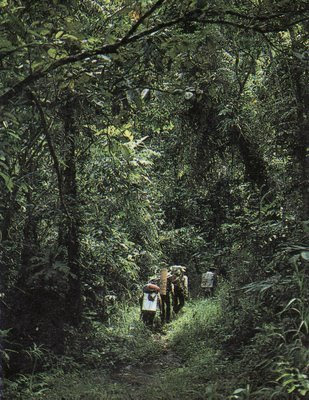
Preceding pages, aftermath of the eruption of Galunggung Volcano in West Java. Left, Mt. Mahameru makes a magnificent appearance above the clouds. Right, hiking through the Borneo rainforest in Dayak country


The Indonesian Archipelago is by far the world's largest-13,617 islands strewn across 5,120 kms (3,200 miles) of tropical seas. When superimposed on a map of North America, this means that Indonesia stretches from Oregon all the way to Bermuda. On a map of Europe, the archipelago extends from Ireland past the Caspian Sea. Of course, four-fifths of the intervening area is occupied by ocean, and many of the islands are tiny, no more than rocky outcrops populated, perhaps, by a few seabirds. But 3,000 Indonesian islands are large enough to be inhabited and New Guinea and Borneo rank as the second and third largest in the world (after Greenland). Of the other major islands, Sumatra is slightly larger than Sweden or California; Sulawesi is roughly the size of Great Britain, and Java alone is as large as England or New York State. With a total land area of 2.02 million sq kms (780,000 sq miles), Indonesia is the world's fourteenth largest political unit.

Befitting its reputation as the celebrated Spice Islands of the East, this archipelago also constitutes one of the most diverse and biologically fascinating corners of our planet. Unique geologic and climatic conditions have created spectacularly varied tropical habitats-from the exceptionally fertile rice lands of Java and Bali to the luxuriant rainforests of Sumatra, Kalimantan, Sulawesi and Maluku, to the savannah grasslands of Nusa Tenggara and the snowcapped peaks of lrian. Found here are an amazing variety of spice, aromatic had hardwood trees (clove, nutmeg, sandalwood, camphor, ebony, ironwood and teak, among others), many unusual fruits (durian, rambutan, lengkeng, salak, blimbing, nangka, manggis, jambu), the world's largest flower (the Rafflesia), the largest lizard (Komodo's monitor), many rare animal species found nowhere else (like the orangutan, the Javan rhinoceros and the Sulawesian anoa-a dwarf buffalo), thousands of varieties of butterflies and wild orchids, and many exquisite plum-age birds-- like the cockatoo and the bird of paradise.

The geological history of the region is complex. All of the islands are relatively young; the earliest dates only from the end of the Miocene, l5 million years ago-just yesterday on the geological time scale. Since that time, the whole archipelago has been the scene of violent tectonic activity, as islands were torn from jostling super continents or pushed up by colliding oceanic plates, and then enlarged in earth wrenching volcanic explosions. The process continues today-Australia is drifting slowly northward, as the immense Pacific plate presses south and west to meet it and the Asian mainland. The islands of Indonesia lie along the lines of impact, a fact that is reflected in their geography and in the great seismic instability of the region.

The islands fall into three main categories of Indonesian Archipelago. Firstly, the large islands of western Indonesia: Sumatra, Kalimantan (Borneo) and Java, together with several smaller adjacent ones (the Riau chain, Bangka, Billiton, Madura and Bali) all rest on the broad Sunda continental shelf that extends down from the Southeast-Asian mainland. The intervening Java Sea is thus very shallow, no more than 100 meters (328 feet)deep at its lowest point, and in fact these islands were often connected to each other and to the mainland during the lce Ages, when sea levels receded as much as 200 meters worldwide and the entire Sunda shelf was exposed as a huge subcontinent. Now these islands are fringed with broad plains that are continually expanding. as new alluvial deposits collect and reclaim the shallow sea.

Vast New Guinea and the tiny islands that dot the neighboring Arafura sea, are connected in similar way by the Sahul continual shelf to Australia. New Guinea was in fact torn off from Australia long ago During a rift movement of the earth's crust.

In between those continental Shelves lie Sulawesi (The Celebes), Maluku and Nusa Tenggara (the Lesser Sundas) – several rugged island arcs which rise from a deep geosynclines that drops as much as 4,500 meters (15,000 feet) below the water's surface.

Geologically all these islands were created Along fault lines where the various tectonic plates of the earth's crust collided and folded at the edges. Subsequently, volcanoes arose along several of these same fault lines.

It is possible to distinguish between two sets of symmetrical folds for each island chain in the archipelago: an older, non-volcanic outer fold and a younger, intensely volcanic inner fold. Running down the west coast of Sumatra is a non-volcanic outer range known as the Mentawai chain of islands. This continues as the southern coastal ranges of Java, Bali, Lombok and western. Sumbawa, and then splits off to form the non volcanic islands of Sumba. Roti. Sawu. Timor, and Tanimbar farther to the east. Parallel to this is an inner, highly volcanic fold that forms the central mountain spines of Sumatra, Java, Bali, Lombok, Sumbawa, and Flores, running through Alor and Wetar to the Banda islands in the east.

Portuguese map of Southeast AsiaEarly 16th Century Portuguese map of Southeast Asia with much ofthe Indonesian archipelago undrawn

Though structurally less well defined, a similar non-volcanic outer fold in the east forms the central ranges of New Guinea, Seram, Buru, and eastern Sulawesi, while an inner volcanic range runs up the western and northern sides of Sulawesi and Halmahera to the Philippines. Within this schema, Borneo forms. along with the Malay peninsula and the mainland, and old and stable non-volcanic core arnd Sulawesi, due to its intermediary position, is geologically the most confused a young volcanic arc (the southwestern central-northern range) welded onto an older, non-volcanic one (the eastern and south-eastern arms).

A Volcanic Legacy

The importance of volcanoes in Indonesia cannot be overstated. Not only do they dominate the landscape of many islands with majestic smoking cones, they also fundamentally alter their size and soils spewing forth millions of tons of ash and debris at irregular intervals. Much of this eventually gets washed down to form gently slopping alluvial plains. Where the ejecta is acidic. the land is infertile and practically useless for agricultural purposes.But where it is basic, as on Java and Bali and in a few scattered localities on other islands. it has Produced the most spectacularly fertile tropical soils in the world.

Of the hundreds of volcanoes, in lndonesia, over 70 remain active and hardly a year passes without a major eruption. On such a densely populated island as Java, this inevitably brings death and destruction. When Mt. Galunggung erupted in West Java in 1982, Many were killed and about 4 million were directly affected through loss of home, land and livelihood.

Yet Galunggung was only a small eruption. Tiny Mt. Krakatau off Java's west coast erupted in 1883 with a force equivalent to that of several hydrogen bombs, creating tidal waves that killed more than 35,00b people on Java. The bang of this eruption, 18 times larger than that of Mt. St. Helens, was heard as far away as Colombo and Sydney, and the great quantities of debris hurled into the atmosphere caused vivid sunsets all over the world for three years afterwards.

Even the Krakatau explosion, however, Was dwarfed by the cataclysmic 181"5 eruption of Mt. Tambora on Sumbawa-the largest in recorded history, in which 90,000 people were killed and over 80 cubic kms of ejected material blocked out the sun for many months, producing the famous "years without summer" of 1816. Geologists say that even greater explosions created Sumatra's Lake Toba and Lake Ranau eons ago.

Climate

Sumatran volcanoEarly Dutch painting depicts a Sumatran volcano

All of the islands in the archipelago lie within the tropical zone, and the surrounding seas exert everywhere a homogenizing effect on temperatures and humidity, so that local variables like topography, altitude and rainfall produce more variation in climate than do latitude or season. Mean temperatures at sea level are uniform, varying by only a few, degrees throughout the region-, and throughout the year (25-28 C/78-82 FF).

In the mountains, however, the temperature decreases about one degree C (two degrees F) for every 200 meters (656 feet) of-altitude, which makes for a cool, pleasant climate in upland towns like Bandung (in West Java: altitude 900 meters [2,950- it]) and Bukit Tinggi (in West Sumatra: altitude 1,000 meters [3.280 ft]).

Much of the Indonesian Archipelago also lies within the equatorial ever wet zone, where no month passes without several inches of rainfall. Most islands receive considerably more than this during the northeast monsoon, which blows down over the South China Sea picking up moisture, then veers to the northwest across the equator, unleashing drenching precipitation wherever it touches land from November through April. Moreover, the tropical sun and the oceans combine to produce continuously high humidity everywhere, and due to local wind patterns, a few places, like Bogor in West Java, receive rain almost daily-as much as 400 cm (200 inches) of it annually!

The Southeast Monsoon nevertheless tends to counteract this generally high humidity by blowing hot, dry air up from over the Australian landmass between May and October. Though much depends on local topography, on most islands this produces a dry season of markedly reduced precipitation, and as one moves south and eastward in the Indonesian Archipelago, the influence of this dessicating Southeast Monsoon increases dramatically. Thus, for example, Sumba and Timor in the Nusa Tenggara chain have an extremely long dry season, with occasional two years droughts. Similarly, the southern Bukit peninsula in Bali is much drier than the rest of the island. as are parts of Java east and south of Surakarta.

Arboreal Canopies

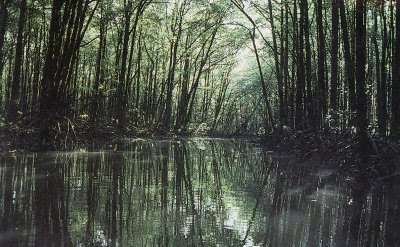
Ujung KulonMangrovesa long the Cihandeuleum River at Ujung Kulon
in West Java

The vegetation found in different parts of the Indonesian Archipelago varies greatly according to rainfall, soil and altitude. On the wetter equatorial islands. the Luxuriance of the rain forests is simply amazing The main canopy of interlocking tree crowns mar be -10 meters (130 ft) from the ground. with individual trees rising as high as 7 meters (230 ft). Beneath this grows a tangle of palms, lianas, Epiphytic ferns, rattans and bamboos, covered by innumerable lichens, mosses and lower plants.

One would imagine that to support such growth the soils would have to be very rich, but this is generally not so. The rain forests of Sumatra, Kalimantan, Sulawesi and Irian typically thrive on very poor and thin soils, that have been heavily leached of minerals by the incessant rains. Cleared of their forest cover by shifting agriculturalists, they support only two or three Meagre crops before being exhausted, eroded or choked with weeds.

How does the rain forest flourish in such circumstances? The answer lies in the nature of its ecosystem, which has brilliantly adapted over millions of years to just such conditions. Essentially, the system holds most of its minerals and nutrients in the form of living tissues. As these die and fall to the ground, they are immediately decomposed and absorbed back up into the system once again. In effect, then, the Rainforest is a self-fertilizing system largely independent of the soil.

On each level, various plants play unique roles in the ecosystem. The upper tree canopy absorbs sunlight and photosyn the-size sit , while maintaining low temperatures and high humidity below. Growth is very slow on the shady lower levels. Lianas wind up from the ground; rattan canes use hooked barbs to grapple and climb; epiphytes simply settle on the branches of big trees.

All plants in the system face shortages of minerals and water, and have therefore developed water storage tubers and other strategies, such as providing shelter and special fluids for ants who in turn deposit their nutrient-rich faces for the plant to use. Some plants resort to piracy, living as parasites-like the garish Rafflesia flower found only in south-central Sumatra, which has no leaves and lives on the ground trailing Tetrastigma vine. Its cabbage-like buds swell and eventually burst open in enermous blooms, five reddish-brown petals splashed with white that can measure one metre across and sometimes weigh nine kgs (20 lbs).

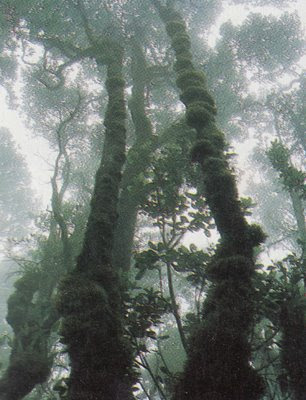
Montane forestMontane forest at Cibodas in West Java

Carnivorous pitcher plants lure unsuspecting insects into liquid-filled cups, where they are dissolved to provide essential nutrients. And the strangler fig settles on a lofty branch, putting down aerial roots that eventually strangle the host tree itself.

Lowland-rain forests display the greatest diversity. Stands of a single tree are rare, rather the lowland forest is composed of a fantastic mosaic of different species, so that in Borneo alone. for example, 3,000 different tree species are known. On this and other islands, many economically valuable hardwood, aromatic and spice trees flourish-including teak, ebony, sandalwood, camphor, clove and nutmeg trees, as well as exotic fruit-bearing species: durian, rambutan, jackfruit, salak, jambu, tamarind, breadfruit and hundreds of varieties of banana and fruit-bearing palms. In New Guinea more than 2,500 species of wild orchids are found in the rainforest, including the world's largest-the tiger orchid (Grammatophyllum Speciosum) with its three meter-long spray of yellow-orange blooms.

Alpine Forests and Mangrove Swamps

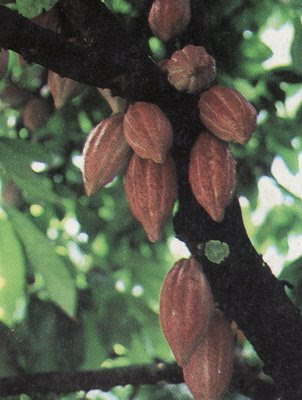
cacao treeFruit of the cacao tree

At high altitudes, temperatures drop and cloud cover increases, resulting in slower growth, fewer species and less complex structure. Rain forest give way to more specialized montane forests, dominated by chestnuts, laurels and oaks. Higher up, one finds rhododendrons and stunted moss forests-dwarf trees draped in lichens. Higher still, there are alpine meadows with Giant edelweiss and other plants more reminiscent of Switzerland than Indonesia. This unexpected habitat can be seen a t Mt. Gede National Park, only 100k ms ( 62m iles) south of hot, humid Jakarta. Indonesia's highest peaks, the Lorentz mountains of Irian Jaya, rise to over 5,000 meters (16,000 feet), and are clad in permanent now fields and glaciers, the only rice fields in the eastern tropics.

Other specialized forests grow on ultra basic rocks, on limestone Karsts, in young volcanic areas and in poorly drained swamps where lack of aeration leads to the build-up of acid peat. In the vast tidal zones of eastern Sumatra, Kalimantan and southern Irian, specialized mangrove trees with looping roots and air-breathing nodules flourish. These trap silt washed down by rivers and creep slowly forward behind a wall of growing coral, forming new land. Mangrove swamps are inhabited by fiddler crabs, fish that skip out of the water, dancing fireflies and the amazing proboscis monkey unique to Borneo.

Moving east from central Java across Bali and Nusa Tenggara, the climate becomes drier and lowland jungles are replaced by deciduous monsoon forests and open savannah grasslands. Depending on how dry the climate is, these forests are partly or wholly deciduous, with fewer species and many broad-leaf trees like teak, which shed their leaves during the dry season. This renders them highly vulnerable to forest fires, and indeed most of the natural forests on Sumbawa, Komodo, Flores and Timor have been either cut or burned off in recent centuries by man. The exposed land has then been devoured by voracious alang-alang (elephant grasses), so that today there are only useless grasslands and scrub where once there were valuable hardwood forests.

Rice in in SumbaA wet-rice paddy in Sumba is "ploughed" by water buffal

Man's presence in the archipelago has not always had an adverse impact on the environment. Indeed, since prehistoric times, man has created exceptionally productive agricultural environments on islands like Java and Bali. This was accomplished through the introduction of irrigated wet rice cultivation to areas that already possessed soil and climatic conditions ideal for agriculture.

Not only are Java and Bali among the few islands where volcanic ejecta is basic and not acidic, so that frequent volcanic eruptions have in fact continually improved the soils by adding mineral-rich nutrients, but they are also areas which achieve something of a golden mean in climate, between the incessant rainfall of the equatorial islands and the extended droughts oT Nusa Tenggara. Java and Bali receive plentiful rainfall and sunshine during alternating dry and wet seasons, each of which lasts half of the year.

It remained, then, for man to harness these natural blessings to his advantage, through the construction of elaborate irrigation networks and labor-intensive wet-rice paddies. The results have been astounding-rice yields under traditional conditions (i.e. before the use of chemical fertilizers and miracle rice strains) that are by far the highest in the world. Such extraordinary fecundity, responsible in great measure for the numerous cultural achievements of the Javanese and the Balinese, has now resulted in runaway population growth. Java today supports 100 million people, two-thirds of Indonesia's population, on only seven per cent of the nation's total land area. This represents an average of over 750 persons per sq km (2.000 per sq mile)-more than twice that of densely populated industrial nations like Japan and Holland. And in many areas of Java, average rural population densities actually soar to an incredible 2,000 persons per sq km (5,000 per sq mile)!

The situation on other islands stands in marked contrast to this. The remaining 50 million Indonesians live spread over more than 90 per cent of the Indonesian Archipelago, with an average population density of only 35 per sq km (90 per sq mile). On some islands, like Kalimantan and Irian,Jaya, this figure drops to around 10 per sq km.

>lontar palmClimbing a lontar palm for tuak

Partly in view of this dramatic population imbalance and partly because of the historical importance of Java as a political center of gravity within the Indonesian Archipelago, many observers tend to distinguish between an Inner Indonesia (i.e. Java and Bali, including Madura and West Lombok) and an Outer Indonesia (all other islands).

Whereas Inner Indonesia has been characterized for centuries by high population densities and labour-intensive irrigated agriculture, Outer Indonesia is the home, traditionally, of dense rain forests, thinly-spread shifting agricultural communities and riverie trading networks. Now, the Outer Islands are also the source of almost all valuable exports: rubber and palm oil (from Sumatran estates), petroleum, copper, tin and bauxite (from Sumatra, Bangka, Billiton and Irian Jaya) and timber (from Kalimantan).

In a sense, the serious ecological problems of over-populated Inner Indonesia are now being exported to the Outer Islands. Java has already suffered for some time from problems of erosion, soil exhaustion and pollution. Now, as the nation's export resources are increasingly being called upon to support a burgeoning population, there are the beginnings of massive deforestation, leading to erosion and the replacement of rainforest by useless grassland.

tea plantationA tea plantation in the cool uplands of Java

These problems have been recognized by the Indonesian government. Realizing, for example, that if indiscriminate clear-felling in Kalimantan timber concessions continues at its present rate, there will be no lowland forest left by the end of the century, they are taking steps to encourage selective cutting and reforestation. Moreover, six per cent of the nation's land has been set aside as nature reserves and national parks. These are not just for the protection of a few wild animals-they safeguard a genetic treasure trove containing many species that may be valuable to man, as well as providing watershed protection and recreational facilities.

Indonesia Since Independence Day


Indonesia Since Independence Day


Indonesia Since Independence Day, Euphoria swept through the cities and towns of Indonesia following the withdrawal of Dutch forces and the secular of Indonesian sovereignty. Mass rallies and processions were held: flag-waving crowds thronged the streets shouting the magical words: " Merdeka, Merdeka!" (Freedom, freedom!). Independence had come at last, and though many obstacles remained Indonesian felt that nothing was impossible now that they held their destiny in their own hands.

Meanwhile. in Jakarta. the slow and arduous process of constructing a peacetime Government had begun. And while the uni-flying power of th6 revolution had done much to forge a coherent state, the fact of Indonesia's remarkable ethnic, religious and ideological diversity remained. Moreover, massive economic and social problems faced the new nation-a legacy of colonialism and war. Factories and plantations were shut down, capital and skilled personnel were scarce, rice production was insufficient to meet demand, the Indonesian people were overwhelmingly poor and illiterate, and the population was growing at an unprecedented.

Gunung Sahara Street(Jakarta's Gunung Sahara Street in the early fifties, a time of national reconstruction)

The inability of any single political group of Indonesia since independence day to effectively dominate it to others clearly called for a system of government in which a variety of interests could be represented. Largely due to the high profile of Dutch-educated intellectuals among the nationalists, a western-style parliamentary system of government was adopted.

From the beginning of Indonesia since independence day, however, the existence of more than 30 rival parties paralyzed the system. A string of weak coalition cabinets rose and fell at the rate of almost one a year, and attempts at cooperation were increasingly stymied not only by a growing ideological polarization, but also by religous and regional loyalties. Parties became more and more preoccupied with ensuring their own survival and less and less attentive toward the nation's pressing economic and social needs,frustrating those who wished to see the revolution produce more tangible results. Most impatient of.all were Sukarno, whose powers as President had been limited b-ythe provisional constitution of 1950, and the army leadership, who felt that their key role during the revolution entitled them to a greater political say.

A series of-uprisings by disaffected groups in Sumatra, North Sulawesi and West Java ever-popular Sukarno declared martial law and give a free hand to crush the rebels. By 1959. with the rebellions under control, Sukarno resurrected the '-revolutionary" constitution of 1945 and declared the beginning of Guided Democracy.


Guided Democracy
1959 - 1965


Indonesia since independence day, under the new political system, power as focused in the hands of the President and the army leadership, at the expense of political parties, whom Sukarno now resarded as counter-revolutionary. Militant nationalism became Sukarno's new recipe for national integration, and the blame for all sorts of economic and political problems was placed squarely at the feet of foreign imperialism and colonialism. In the international arena, Sukarno had, in 1955, made a significant impact by convening the Asia Africa Conference in Bandung. Attended by leaders such as Chou En-lai, Nehru and Nassar, the conference led to the formation of a non-aligned movement and placed Indonesia in the forefront among emergent Third World nations.


Soekarno Hatta CabinetSukarno (center) with his first cabinet, of which Hatta (right of Sukarno) was vice-president

In the early 1960s Soekarno's anti-colonial sentiments took a more militant turn. A long and successful campaign to wrest control of western New Guinea from the Dutch was followed closely by military confrontation with newly independent Malaysia, in 1963. Sukarno's audacity and growing contempt for the United States ("To hell with your aid!" he told the Americans) earned him the reputation of infant terrible among Asian leaders.

Soekarno's nationalistic 6lan was in some ways just what Indonesia needed. Many Indonesians saw in him a kind of father figure-a natural leader who offered a vision of a strong and independent Indonesia not seen since the 14th Century, during the reign of the powerful empire,of Majapahit.

Yet Soekarno's reliance on his charisma, and his lack of attention to day-to-day administration created a vacuum in which the government and the nation floundered. While Soekarno attempted to offset the growing influence of the military by identifying himself more closely with the most active of the civilian parties, the communist PKI, the nation's economy ground to a halt. Foreign investment fled, deficits left the government bankrupt and inflation skyrocketed to an annual rate of 680 per cent. By 1965, the year that Sukarno christened, "The Year of Living Dangerously," social, cultural and political ferment was intense.


The 1965 Coup

The political tinderbox was ignited in the early hours of Oct 1, 1965 when with the apparent encouragement of the PKI. a group of radical young army officers kidnaped and brutally .Executed six leading generals, claiming that they were plotting against the President. Failing to gain Soekarno's backing. however. the rebel officers soon lost the initiative to General Soeharto, then head of the elite Army Strategic Reserve. In the space of a few hours.Soeharto moved to assume command of the army and to crush the attempted coup.


Soekarno and Nehru( Nehru (left) standing with Sukarno(right) During a state visit of 1957)


The nation was shocked by news of the generals' execution.and. although the exact extent to which PKI leaders were involved is still not clear, the communists were charged with attempting to overthrow the government. A state of anarchy ensued, in which moderate, Muslim and army elements sought to settle the score. Thousands upon thousands were killed as long-simmering frustrations erupted into mob violence first in northern Sumatra, then later in Java,Bali and Lombok. The bloodletting continued for months, and the period 1965-66 is remembered today as the darkest in the Republic's history.

Meanwhile.in Jakarta. a political struggle broke out between the army, supported by students, intellectuals. Muslims and other middle-class groups on the one hand, and Sukarno, with his considerable populist/nationalist following on the other. Finally on March 11th, 1966, Sukarno was persuaded to sign a document bestowing wide powers on General Suharto.

Although Suharto was not formally installed as Indonesia's second president until 1968, immediate reforms were carried out under his direction. Martial law was declared and order was restored. 'the communist party, Marxist-Leninist teachings were outlawed. The civil administration was radically restructured and restaffed by military personnel. A major realignment in foreign policy restored relations with the United States and the West, while severing ties with China and the Soviet Union.

Economic 'New Order"

Indonesia since independence day building its political legitimacy upon promises to revive the moribund Indonesian economy, the new Suharto administration wasted no time in addressing the fundamental problems of inflation and stagnation. American-trained economists were called upon to over see the rapid reintegration of Indonesia into the world economy. and in a short space of time, foreign investment laws were liberalized, monetary controls were imposed, and western aid was sought and received to replenish the nation's exhausted foreign exchange reserves. These measures formed the cornerstones of Suharto's economic "new order." and served to dramatically curb inflation and to set the nation on a course of rapid economic growth by the early l970s.


Soekarno and Soeharto(Right, Soekarno reads a statement to the press handing over power,
while his success or Suharto looks on)

Indonesian first five-year plan. Repelita I was design to encourage growth by attracting foreign investment. Most of the targets of the plan were achieved-a first wave of investors moved in to take advantage of Indonesia's vast natural reserves of copper,tin, timber and oil, setting up facilities to extract these raw materials in Sumatra, Sulawesi, Kalimantan and Irian Jaya. As the political stability of the region seemed more assured a second wave of investors, largely Japanese and local Chinese, set up a wide variety of urban-based manufacturing industries. By 1915, textile manufacturing alone accounted for US$708 million worth of investments, and the economy was rocketing.

By far the greatest benefits, however, came from oil. The story began in northern Sumatra in 1883 when a Dutch planter took shelter from a storm in a native shed and noticed a wet torch burning brightly. Inquiring about this, he was led to a near by spring where a black viscous substance lay thick across the water. The discovery soon led to the formation of Royal Dutch shell Company, and eventually to the establishment of Indonesia as the world's fifth largest OPEC producer.

From a total of US$323million in i966, oil exports rose to US$5.2 billion in 1974, largely due to the steep OPEC price hikes of the early 1970s. Now oil has come to account for roughly 60 per cent of the state's total revenues, and the flood of petrodollars has been used to fund not only a number of capital works programs but also a significant upgrading of the nation's huge civil service.The most impressive advances have been in education. particularly at the primary level. Between 1912 and [97t1. no less than 26,677 primary schools were built, bringing the percentage of children enrolled from 69 to 84. Primary school teachers now account for roughly I third of the nation's 2.3 million government employees.

Indonesia's civil service though is not without its problems. Despite 106 per cent across-the-board wage hikes in the early 1970s,pay levels remain low. In 1983,over 70 per cent of civil servants were receiving less than US$20 per week. Inefficiency and corruption are the result, compounding a serious lack of expertise and training. Only 26 per cent of all government employees (including teachers)have more than a junior high school education.

A different sort of problem arose within the government body responsible for the oil bonanza, the State Oil and Natural Gas Corporation, Pertamina. In the early 1970s, under the direction of Colonel Ibnu Sutowo. Pertamina poured huge sums of money into projects intended to reduce Indonesia's dependence on foreign technology and imports. These included a floating fertilizer plant to be anchored over offshore gas fields, the massive Krakatau steel mill in West Java, a three-million-ton tanker fleet, petrochemical and refining plants, as well as several non-industrial projects such as a first-class hospital, a sports stadium, a chain of hotels, an airline and a golf course.

Liberation of lrian Jaya(In Jakarta, the monument commemorating
the "liberation" of lrian Jaya)

Ibnu Sutowo's flamboyant spending came to an abrupt halt in 1975, when Pertamina announced that it was defaulting on one of its foreign bank loans. Sutowo,it turned out, had recklessly borrowed money that he had no chance of repaying, clocking up over $10 billion in foreign debts in the process!In the end, the Indonesian government was saddled with one of the largest peace time losses any country has ever suffered, and many industrial projects had to be scrapped or rescheduled.


Peace and Progress

Despite these and other problems, the 1970s and early 1980s have been characterized by relative political stability. The tenor of the Suharto regime and its supporters is well caught by the slogan, "Development yes,politics n-o!"Opposition political parties have been restricted and closely supervised, managing to poll only 40 per cent in the 1971 election and even less in 1977 and 1982. The big winner. meanwhile, has been the government's political "functional" group, Golkar, consisting of representatives chosen from various professional, religious, ethnic and military constituencies.

Yet politics refused to go away entirely. A proposed secular marriage law brought an angry response from Indonesia's Muslim majority in 1973 and had to be dropped. And pressure has mounted for the government to provide for a greater distribution of the wealth and benefits of economic growth, to curb the level of foreign debt, to contain inflation and to eradicate corruption. Frustration, particularly over economic matters, has erupted in the past, notably on the occasion of Japanese Prime Minister Tanaka's visit to Jakarta in I974, when the capital was rocked by two days of violent student demonstrations.

Among the influential middle class, however, opposition has been muted by the very prosperity the "New Order" has helped to generate. Most Indonesians consider themselves better off today than ever before-there are far more cassette players, motorbikes, cars, telephones, televisions and other consumer goods around than there have ever been.


Striking advances have also been made in the vital areas of population control and agriculture. In 1980, Indonesia's population was counted at 147 million. Java and Bali are the most seriously over crowded islands,representing only seven per cent of Indonesia's total land area, while housing two thirds of her people-equivalent to the entire population of the United States occupying the state of California.

The government first attempted to ease the pressure with transmigration-the resettlement of Javanese and Balinese villagers to the sparsely populated islands of Sumatra, Kalimantan and Sulawesi. Transmigration has proved slow and costly, though, and since 1970 has been complemented by an intensive family planning campaign, that has managed to reduce the birth rate from over two per cent to around 1.8 per cent per annual.

Directly linked to the population situation is the challenge of food production. The a highest,priority has been given to rice, lndonesia's staple food. The introduction of new high-yield plant strains, multiple croppings better irrigation, chemical fertilizers and pesticides has resulted in a spectacular 50 per cent increase in rice production between 1974 and 1984, A government rice stockpiling and distribution network has also reduced the threat of famine. stabilized prices and provided credits and subsidies to farmers.

oil exploration in Sumatra(Early oil exploration in Sumatra-where Indonesia's vital
oil revenue originated)

The problem has not yet been solved, however. Bad weather and insect infestations caused serious shortfalls in 1977. forcing Indonesia to import one third of the world's surplus rice. Since then, the introduction of a new pest-resistant rice strain and further intensification has raised average yields by 2l per cent, making Indonesia virtually self-sufficient in rice. Whether levels of production can keep pace with the rapidly increasing demand is the central question.The weather,of course,remains a key variable, though increase irrigation is reducing some of the uncertainty.

Indonesia OPEC producer(As the world'sfifth largest OPEC producer,the nation's economy is heavily dependent on oil)

Other food and export crops have not fared so well. Production of vital crops such as rubber. copra, peanuts,oil palms, soybeans, cassava and maize has remained virtually stagnant over the past decade, and in some cases has actually declined. Sugar has been the notable exception. and is a possible model for future governmental intervention in other areas. Where as Indonesia spent US$700 million on sugar imports in 1981, increased cultivation and higher price incentives reduced the figure US$261 million in l982 and Indonesia now a nett exporter of sugar.

On the intensely cultivated island of Java it is estimated trait only a quarter of the population own land. And as the population expands, so agriculture absorbs a progressively smaller percentage of the total labor force. In 1960 the figure was over 75 per cent, while now only about 55 per cent of Javanese are engaged in food production. This has created a massive unemployment problem, in which millions of landless laborers have moved into the cities to seek work.

Some of these migrants have been absorbed into the budding manufacturing sector. Yet despite the priority afforded the development of an urban industrial base in the government's second five-year plan, repelita II, job opportunities in industry have not managed to keep pace with a labor force that is growing by 1.4 million a year. As a result, these young people lead a hand-to-mouth existence in the cities--driving pedicabs, peddling noodles and fried bananas, selling cigarettes, shining shoes and scavenging from garbage dumps. Their plight represents one of the major challenges facing Indonesia now.

Unfortunately. "the world economic recession and oil glut of the early l9S0s has created financial circumstances which have temporarily pushed all other problems to the rear. Indonesia has recently been forced to cut back oil production and to reduce prices significantly. The resulting drop in oil revenues exacerbated by the declining value of other key exports and reductions in foreign industrial investment, has led to a critical shortage of foreign exchange and a drop in the economic growth rate to only two per cent in 1982.

The guiding principles of the government's present economic strategy are export promotion and import substitution-selling more abroad and importing less. Oil refining is one area in which significant advances have been made towards the goal of self-sufficiency. Indonesia now boasts eight state-run refineries, the largest of which are in central Java and east Kalimantan, and refining capacity is now supply in gall of the domestic demand for kerosene and gasoline.

Significant savings have also been realized through domestic fertilizer production. Indonesia's first plant was opened at Palembang, South Sumatra, in 1964 with a capacity of I00,000 tons per year. Fed by abundant supplies of local natural gas, the state-owned plant has over the years developed into the world's largest urea-producing complex,now turning out more than 1.6 million tons a year.

In the realm of exports, lndonesia's most promising source of revenue is natural gas. Massive reserves totaling over 7l trillion cubic meters were discovered in east Kalimantan and in Aceh, northern Sumatra. In 197l, Since then, liquid natural gas (LNG) plants have been set into operation at both sites, and Indonesia now ranks as the world's number one exporter of LNG, with 1982 revenues of over US$2.6 billion.

Yet another industrial priority has been cement production. In the past decade the number of plants has more than trebled, and production has risen twelve fold.

Indonesia's other manufacturing industries are more embryonic. Almost 90 per cent of those employed in this sector work in small-scale cottage industries, producing basic items such as salt, coconut oil and furniture.Larger factories more dependent upon imported machinery and capital have had some success in supplying consumer goods for the local market in recent years.In 1982, for example, Indonesia produced 847,000 television sets, assembled 210,000 cars and trucks and over half-a-million motor bikes.

Indonesia exporter of natural gas(Indonesia is also the world's exporter of natural gas)

The government has pinned its future hope son labour-intensive,export-oriented manufacturing and they are predicting an industrial "take-off " for Indonesia during the latter half of the 1980s. It is hoped that this will provide jobs and prosperity for a population that is expected to reach 1 212 million by the year 2,000.

The Independence Day Of Indonesia

The Independence Day Of Indonesia

Members of a Dutch household
(Members of a Dutch household)

The Rocky Road To Independence Day Of Indonesia, at the beginning of the 20th Century, signs of change were everywhere in the Indies. Dutch military expeditions and private enterprises were making inroad into the hinterlands of Sumatra and the eastern islands. Steam shipping and the Suez Canal (opened in 1869) had bought Europe closer, and the European presence in Java was growing steadily. Gracious new shops, clubs, hotels and homes added an air of cosmopolitan elegance to the towns, while newspapers, factories, gas lighting, trains, tramways, electricity and automobiles imparted a distinct feeling of modernity. Indeed, thousands of newly arrived Dutch immigrants were moved to remark on the extremely tolerable conditions that greeted them in the colonies-that is to say, it was just like home or even better.

But if Netherlands India was becoming increasingly Europeanized, elsewhere in Asia turn-of-the-century modernization was bring in with it a new spirit of nationalism-reflected in the Meiji Restoration and the Japanese victory over Russia (1898), the revolution in China (1911) and the Chulalongkorn reforms in Thailand (1873-1910).

In the indies, nationalism was slow in developing, but just as inevitable. A small but growing number of Indonesians were receiving Dutch educations, and by the turn of the century came the remarkable figure of Raden Ajeng Kartini (1879-1904), the daughter of an enlightened Javanese aristocrat whose ardent yearnings for emancipation were articulated in a series of letters written in Dutch (now published in English as Letters of a Javanese Princess, with a foreword by Eleanor, Roosevelt).

The irony is, from a Dutch point of view, that 19th Century European idealism provided much of the intellectual basis of Indonesian nationalism. As early as 1908, Indonesian attending Dutch schools began to form a number of regional student organizations dedicated to the betterment of their fellows. Though small, aristocratic and extremely idealistic, such organizations nonetheless spawned an elite group of leaders and provided forums in which a new national consciousness was to take shape.

A National Awakening

In 1928, at the second all-Indies student conference, the important concept of a single Indonesian nation (one people, one language, one nation) was proclaimed in the so-called sumpah pemuda (youth pledge). The nationalism and idealism of these students later spread in the print media and through the non-government schools. By the 1930s as many as 130,000 pupils were enrolled in these “wild” (i.e. non-government) Dutch and Malay-medium schools-twice the total attending government schools.

Opposition to the Dutch(Opposition to the Dutch found a voice in groups such as these medical students)

The colonial authorities watched the formation of the Dutch-educated urban elite with some concern. Two political movements of the day provided much greater cause for alarm, however. The first and most important of these was the pan-Islamic movement which hadits roots in the steady and growing stream of pilgrims visiting Mecca from the mid-19th Century onwards, and in the religious teachings of the ulama (Arabic shcolars). What began in Java in 1909 as a small Islamic traders association (Sarekat Dagang Islamiyah) soon turned into a national confederation of Islamic labor unions (Sarikat Islam) which claimed 2 million members in 1919. Rallies were held, sometimes attracting as many as 50,000 people, and many peasants came to see in the Islamic movement some hope of relief from oppressive economic conditions.

The Indonesian communist movement was also founded around 1910 by small groups of Dutch and Indonesian radicals. It soon moved to embrace both Islam and international communism. Many of its leaders gained control of local Islamic workers’ union and frequently spoke at Islamic rallies, but after the Russian revolution of 1917, also maintained ties with the Comintern and increasingly espoused Marxist-Leninist doctrine. The period from 1910 to 1930 was a turbulent one. Strikes frequently erupted into violence, and while at first the colonial government took a liberal view of these rebellious activities, many Indonesian leaders were eventually arrested and moderate Muslim leaders soon disassociated themselves from political activities. The rank-and-file deserted their unions, and while the communists fought on for several years, staging a series of poorly organized local rebellions in Java and Sumatra up through 1927, they too were crushed.

Indonesian Communist(The movement for Independence Day Of Indonesia spawned marches and gatherings.
Despite Dutch intentions to return to Indonesia after the Japanese defeat,
Independence came in 1950)

Leadership of the anti-colonial movement then reverted to the student elite. In 1927, a recently graduated engineer by the name of Sukarno, together with his Bandung Stud Club, founded the first major political party with Indonesian independence as its goal. Withing two years his so-called Partai Nasional Indonesia (PNI) had over 10,000 members, due in large part to Soekarno’s gifted oratory. Shortly thereafter, Sukarno was arrested for “openly treasonous statements against the state.” Though publicity tried (in Bandung) and then imprisoned, he was later released. A general crackdown ensued and after 1933, Sukarno and all other student leaders were exiled to distant islands where they remained for almost then years. Ringing in their ears as they were sent off was the statement by then Governor-General de Jonge that the Dutch had “been here for350 years with stick and sword and will remain here for another 350 years with stick and swords.” The flower of secular nationalism, it would seem, had been effectively nipped in the bud.

The Japanese Occupation

There was a king of 12th Century Java, Jayabaya by name, who had prophesied that despotic white men would one day rule but that following the arrival of yellow men from the north (who would remain just as long as it takes the maize to ripen), Java would be freed forever of foreign oppressors and would enter a millennial golden age. When the Japanese invasion came, it is not surprising that many Indonesians interpreted this a liberation from Dutch rule.

The immediate effect of the Japanese invasion of Java in January, 1942 was to show that Dutch military might was basically a bluff. The Japanese encountered little resistance and within just a few weeks they rounded up all Europeans and placed them in concentration camps. Initially there was jubilation, but it immediately became apparent that the Japanese had come to exploit the Indies not to free them.

Throughout the occupation all imports were cut off and Japanese rice requisition steadily increased, creating famines and sparking peasant uprisings which were them ruthlessly put down by the dreaded Kempeitai or Japanese secret police.

Bung Tomo(Bung Tomo, an Indonesian hero from Surabaya)

Still, the Japanese found it necessary to rely on Indonesians and to promote a sense of Indonesian nationhood in order to extract their desired war material Indonesian were placed in many key positions previously held by Dutchmen. The use of the Dutch language was banned and replaced by Indonesian. And nationalist leaders were freed and encouraged to cooperate with the Japanese, which almost of them did. All these factors contributed to growing sense of Indonesian confidence.

When it eventually became apparent, in late 1944 that Japan was losing the war, the Japanese began to promise independence in an attempt to maintain faltering Indonesian support. Nationalist slogans were encouraged, the nationalist anthem (Indonesia Raya) was played, the Indonesian “Red and White”flew next to the “Rising Sun,” Indonesian leaders were brought together for discussions and close to 200,000 young people were hurriedly mobilized into para-military groups. By this point there was clearly no chance of turning back.

Revolution: 1945-1950

Before The Independence Day Of Indonesia, on Aug.9, 1945, the day the second atomic bomb was dropped, there Indonesian leaders were flown to Saigon to meet with the Japanese Commander for Southeast Asia, Marshal Terauchi. The marshal promised them independence for all the former Dutch possessions in Asia and appointed Soekarta chairman of the preparatory committee with Mohammed Hatta as vice-chairman. They arrived back in Jakarta on August 14th and the very next day Japan surrounded unconditionally to the Allies. Following two days of debate, Soekarno and Hatta were persuaded to proclaim merdeka (Independence Day Of Indonesia) on August 17th and the long process of constructing a government was begun.

Indonesia Revolution
The following months were chaotic. News of the Japanese surrender spread like fire and millions of Indonesian enthusiastically echoed the call for merdeka! The Dutch eventually returned, but Holland was at this time in a shambles and world opinion was against them.

The national leaders, too, were hesitant and divided, awed by the swift course of events and undecided whether to press for full victory or negotiate a compromise. The ensuing struggle was this a strange combination of bitter fighting, punctuated by calm diplomacy.

In the end, heroic sacrifices on the battle field by tens of thousands of Indonesian youth placed the Dutch in an untenable position. Three Dutch “police actions” gave the returning colonial force control of the cities, but each time the ragtag Indonesian army valiantly fought back, and to all foreign observers it became clear that the revolution would drag on for years if a political solution were not achieved.

Finally in January, 1949, the United States halted the transfer of Marshall Plan funds to the Netherlands and the UN Security Council ordered the Dutch to withdraw their forces and negotiate a settlement. This done, Dutch infuence in Indonesia rapidly crumbled, and on Aug. 17, 1950-the fifth anniversary of the merdeka proclamation-all previous governments and agreements were unilaterally swept away by the new government of the Republic of Indonesia.

History Of The Dutch in Indonesia

History Of The Dutch in Indonesia


The saga of the Dutch in Indonesia began in 1596, when four small Dutch vessels led by the incompetent and arrogant Cornelis de Houtman anchored in the roads of Banten, then the largest pepper-port in the archipelago. Repeatedly blown off course and racked by disease and dissension, the de Houtman expedition had been a disaster from the start. In Banten, the sea-weary Dutch crew went on a drinking binge and had to be chased back to their ships by order of an angry prince, who then refused to do business with such unruly farang. Hopping from port-to-port down the north coast of Java, de Houtman wisely confined his sailors to their ships and managed to purchase some spices. But upon arriving in Bali, the entire crew jumped ship and it was some months before de Houtman could muster a quorum for the return voyage.

Arriving back in Holland in 1597 after ab absence of two years, with only three lightly laden ships and a third of their crew, the de Houtman voyage was nonetheless hailed as a success. So dear were spices in Europe at this time, that the sale of her meager cargoes sufficed to cover all expenses and even produced a modest profit for the investors!. This touched off a veritable fever of speculation in Dutch commercial circles, and in the following year fivce consortiums dispatched a total of 22 ships to Indies.

Dutch expedition to Java(Early Dutch expedition to Java)


The Dutch East India Company

The Netherlands was at this time rapidly becoming the commercial centter of Northern Europe. Since the 15th Century, ports of the two Dutch coastal provinces, Holland and Zeeland, had served as enter pots for goods shipped to Germany and the Baltic states. Many Dutch merchants grew wealthy on this carrying trade, and following the out-break of war with Spain in 1568, they began to expand their shipping fleets rapidly, so that by the 1590s they were trading directly with the Levant and Brazil.

Thus when a Dutchman published his itinerary to the East Indies in 1595-6, it occasioned the immediate dispatch of the de Houtman and later expeditions. Indeed, so keen was the interest in direct trade with the Indies, that all Dutch traders soon came to recognize the need for cooperation-to minimize competition and maximize profits. In 1602, therefore, they formed the United Dutch East India Company (known by its Dutch initials-VOC), one of the first joint-stock corporations in history. It was capitalized at more than 6 million guilders and empowered by the states-general to negotioate treaties, raise armies, build fortresses and wage war on behalf of the Netherlands in Asia.

Van Lisnschoten(Van Lisnschoten - author of the first "guide book" to the Indies)

The VOC’s whole purpose and philosophy can be summed up in a single word-monopoly. Like the Portuguese before them, the Dutch dreamed of securing absolute control of the East Indies spice trade, which traditionally had passed through many Muslim and Mediterranean hands. The profits from such a trade were potentially enormous, in the order of several thousand per cent.

In its early years the VOC met with only limited success. Several trading posts were opened, and Ambon was taken from the Portuguese (in 1605), but Spanish and English, not to mention Muslim, competition kept spice prices high in Indonesia and low in Europe. Then in 1614, a young accountant by the name of Jan Pietieszoon Coen convinced the directors that only a more forceful policy would make the company profitable. Coen was given command of VOC operations, and promptly embarked on a series of military adventures that were to set the pattern for Dutch behavior in the region.

Jan Pieterszoon Coen(Jan Pieterszoon Coen, architect of Dutch empire in the East)


The Founding of Batavia

Coen’s first step was to establish a permanent headquarters at Jayakarta on the north-western coast of Java, close to the pepper producing parts of Sumatra and the strategic Sunda Straits. In 1618, he sought and received permission from Prince Wijayakrama of Jayakarta to expand the existing Dutch post, and proceeded to throw up a stone barricade mounted with cannon. The prince protested that fortifications were not provided for in their agreement and Coen responded by bombarding the palace thereby reducing it to rubble. A seige of the fledgling Dutch fortress ensued, in which the powerful Bantenese and a recently arrived English fleet joined the Jayakartans. Coen was not so easily beaten, however (his motto:”Never Dispair!”), and escaped to Ambon leaving a handful of his men in defense of the fort and its valuable contents.

Five months later, Coen returned to discover his men still in possession of their post. Though outnumbered 30-to-1 they had rather unwittingly played one foe against another by acceding to any and all demands, but were never actually required to surrender their position due to the mutual suspicion and timidity of the three attacking parties. Coen set his adversaries to flight in a series of dramatic attacks, undertaken with a small force of 1,000 men that included several score of fearsome Japanese mercenaries. The town of Jayakarta was razed to the ground and construction of a new Dutch town begun, eventually to include canals, drawbridges, docks, warehouse, barracks, a central square, a city hall and a church-all protected by a high stone wall and a moat-a copy in short, of Amsterdam itself.

Dutch trading post at Banda Neira(Natives bring nutmegs for sale to a Dutch trading post at Banda Neira)

The only sour note in the proceedings was struck by the revelation that during the darkest days of the seige, many of the Dutch defenders had behaved them selves in a most unseemly manners-drinking, singing and fornicating for several nights in succession. Worst of all, they had broken open the company storehouse and divided the contents up amongst themselves. Coen, a strict disciplinarian, ordered the immediate execution of those involved, and memories of the infamous siege soon faded-save one. The defenders had dubbed their fortress “Batavia,” and the new name stuck.

Coen’s next step was to secure control of the five tiny nutmeg-and mace-producing Banda Islands. In 1621, he led an expeditionary force there, and withing a few weeks rounded up and killed most of the 15,000 inhabitants on the islands. Three of the islands were then transformed into spice plantations managed by Duth colonists and worked by slaves.

In the years that followed, the Dutch gradually tightened their grip on the spice trade. From their base at Ambon, they attempted to “negotiate” a monopoly in cloves with the rulers of Ternate and Tidore. But “leakages” continued to occur. Finally, in 1649, the Dutch began a series of yearly sweeps of the entire area, the infamous hongi (war-fleet) expeditions de islands other than Ambon and Seram, where the Dutch were firmly established. So successful were these expeditions, that half of the islanders starved for lack of trade, and the remaining half were reduced to abject poverty.

Still, the smuggling of cloves and clove trees continued. Traders obtained these other goods at the new Islamic port of Makassar, in southern Sulawesi. The Dutch repeatedly blockaded Makassar and imposed treaties theoretically barring the Makassarese from trading with other nations, but were unable for many years to enforce them. Finally, in 1669, following three years of bitter and bloody fighting, the Makassarese surrendered to superior Dutch and Buginese forces. The Dutch now placed their Bugis ally, Arung Palakka, in charge of Makassar. The bloodletting did not stop here, however, for Arung Palakka embarked on a reign of terror to extend his control over all of southern Sulawesi.

Jayakarta(On the site of Jayakarta, the new town of Batavia had many of the features
of Amsterdaam)

The Dutch in Java

By such nefarious means the Dutch had achieved effective control of the eastern archipelago and its lucrative spice trade by the end of the 17th Century. In the western half of the archipelago, however, they became increasingly embroiled in fruitless intrigues and wars, particularly on Java. This came about largely because the Dutch presence at Batavia disturbed a delicate balance of power on Java.

As early as 1628, Batavia came under Javanese attack. Sultan Agung (1613-46), third and greatest ruler of the Mataram kingdom, was then aggressively expanding his domain and had receltly concluded a successful five-year siege of Surabaya. He now controlled all of central and eastern Java, and next, he intended to take western Java by pushing the Dutch into the sea and then conquering Banten.

He nearly Succeed. A large Javanese expeditionary force momentarily breached Batavia’s defences, but was then driven back outside the walls in a last-ditch effort led by Governor-General Coen. The Javanese were not prepared for such resistance and withdrew for lack of provisions. A year later in 1629, Sultan Agung sent an even larger force, estimated at 10,000 men, provisioned with huge stockpiles of rice for what threatened to be a protracted siege. Coen, however, learned of the location of the rice stockpiles and captured of destroyed them before the Javanese even arrived. Poorly led, starving and sick, the Javanese troops died by the thousands outside the walls of Batavia. Never again did Mataram pose at threat to the city.

Relations between the Dutch and the Javanese improved during the despotic reign of Amangkurat I (1646-77), one reason being that they had common enemies-the pesisir trading kingdoms of the north Java coast.

It was ironic, then, that the Dutch conquest of Makassar later resulted, albeit in directly, in the demise of their “ally”.

The Makassar warsof 1666-69, and their aftermath, created a diaspora of Makassarese and Buginese refugees. Many of them fled to eastern Java, where they united under the leadership of a Madurese prince, Trunajaya. Aided and abetted by none other than the Mataram crown prince, Trunajaya succesfully stormed through Central Java and pludered the Mataram capital in 1676-7. Amangkurat I died fleeing the enemy forces.

Once in control of Java, Trunajaya renounced his alliance with the young Mataram prince and declared himself king. Having no one else to turn to, the crown prince pleaded for Dutch support, promising to reimburse all military expenses and to award the Dutch valuable trade concessions. The bait was swallowed, and a costly campaign was promptly mounted to capture Trunajaya. This ended, in 1680, with the restoration of the crown prince, now styling himself Amangkurat II, to the throne.

Dutch Colonialism
(19th Century prints capture some of the adjuncts of colonialism)

But the new king was then in no position to fulfill his end of the bargain with the Dutch-his treasury had been looted and his kingdom was in ruin. All he had to offer was territory, and although he ceded much of western Java to the VOC, they still suffered a heavy financial loss.

On December 31, 1799, Dutch financiers received stunning news-the VOC was bankrupt!. During the 18th Century, the spice trade had become less profitable, while the military involvement in Java had grown increasingly costly-this at least is the broad outline of events leading to one of the largest commercial collapses in history.

It was a great war in Java (1740-55), however, which dealt the death blow to delicate Dutch finances. And once again, through a complex chain of events, it was the Dutch themselves who inadvertently precipitated the conflict. The details of the struggles are too convoluted to follow here, but it began in 1740 with the massacre of the Chinese residents of Batavia, and ended 15 years later, only after many bloody battles broken alliances and kaleidoscopic shifts of fortune had exhausted (or killed) almost everyone on the island. Indeed Java was never the same again, for by the 1755 Treaty of Giyanty, Mataram had been cleft in two, with rival rulers occupying neighboring capitals in Yogyakarta and Surakarta. Nor did the VOC ever recover from this drain on its resources, even though it emerged at this time as the pre-eminent power on Java.


Daendels and Raffles

It is one of the great ironies of colonial history that to fully exploit that to fully their colony, the Dutch had to first lose their shirts. The domination of Java-achieved at the expense of VOC bankruptcy-profited the Dutch handsomely in the 19th Century.

In the traumatic aftermatch of the VOC bankruptcy, there was a great indecision in Holland as to the course that should be steered in the Indies. In 1800, the Netherlands government assumed control of all former VOC possessions, now renamed Netherlands India, but for many years no one could figure out how to make them profitable. A number of factors, notably the Napoleonic Wars, compounded the confusion.

A new beginning of sorts was finally made under the iron rule of Governor-General Marshall Daendals (1808-11), a follower of Napoleon who wrought numerous administrative reforms, rebuilt Batavia, and constructed a post road the length of Java.

Thomas Stamford Raffles (1811-1816)-
The English interregnum-a brief period of English rule under Thomas Stamford Raffles (1811-1816)-followed. Raffless was in many ways an extraordinary man: a brilliant scholar, naturalist, linguist, diplomat and strategist, “discover” of Borobudur and author of the monumental History of Java. In 1811, he planned and led the successful English invasion of Java, and was then placed in charge of its government at the tender age of 32. His active mind and free trade philosophy led him to promulgate reforms almost daily, but the result was bureaucratic anarchy. Essentially, Raffles wanted to replace the old mercantilism system (from which the colonial government derived its income through a monopoly on trade), by one which income was derived from taxes, and trade was unrestrained. This enormous tast was barely begun when the order, came from London, following Napoleon’s defeat at Waterloo in 1815, to restore the Indies to the Dutch. Raffles’ legacy lived one, however. Many of his land taxes were eventually levied by the Dutch, and they in fact made possible the horrible exploitation of Java in later years. And his invasion of Yogyakarta in 1812 led ultimately to the cataclysmic Java War of 1825-30.

Dutch Army In Aceh(The Dutch Army poses after a victory over Acehnese forces)

From Carnage to “Cultivation”

So numerous were the abuses leading to the Java War, and so great were the atrocities commited by the Dutch during it, that the Javanese leader, Pangeran Diponegoro (1785-1855), has been proclaimed a great hero even by Dutch historians. He was indeed a charismatic figure-crown prince, Muslim mystic and man of the people-who led a series of uprisings against the Dutch trick; lured to negotiate, Diponegoro was captured and exiled to Sulawesi. The cost of the conflict in human terms was staggering-200,000 Javanese and 8,000 Europeans lost their lives, many more from starvation and cholera than on the battle-field.

By this time, the Dutch were indeed in desperate economic straits. All efforts at reform had ended in disaster, to put it mildly, and the government debt had reached 30 million guilders!. New ideas were sought, and in 1829, Johannes van den Bosch submitted a proposal to the crown for what he called a culture Stengel or “Cultivation System” of fiscal administration in the colonies. His unoriginal notion was to levy a tax of 20 per cent (later raised to 33 per cent) on all land in Java, but to demand payment not in rice, but in labour or use of the land. This, he pointed out, would permit the Dutch to grow crops that they could sell in Europe.

Van den Bosch soon assumed control of Netherlands India, and in the estimation of many, his Cultivation System was an immediate, unqualified success. In the very first year, 1831, it produced a profit of 3 million guilders and within a decade, more than 22 million guilders were flowing annually into Dutch coffers, largely from the sale of coffee, but also from tea, sugar, indigo, quinine, copra, palm oil and rubber.

With the windfall profits received from the sale of Indonesian products during the rest of the 19th Century, almost a billion guilders in all, the Dutch not only retired their debt, but built new waterways, dikes, roads and a national railway system. Indeed, observes like Englishman J. B. Money whose book Java, or How To Manage A Colony (1861) was received in Holland with a great fanfare, concluded that the system provided a panacea for all colonial woes.

In reality of course, the pernicious effects of the Cultivation System were apparent from the beginning. While in theory the system called for peasants to surrender only a portion of their land and labour, in practice certain lands were worked exclusively for the Dutch by forced labour. The island of Java one earth, was thus transformed into a huge Dutch plantation. As noted by a succession of writers, beginning with Multatuli (nom de plume of a disillusioned Dutch colonial administrator, Douwes Dekker) and his celebrated novel Max Havelaar (1860), the system imposed unimaginable hardships and injustices upon the Javanese.

The long-range effects of the Cultivation System were equally insidious and are still being felt now. The opening up of new lands to cultivation and the ever-increasing Dutch demand for labour resulted in a population explotion on Java. From an estimated total of between 3 and 5 million in 1800 (a figure kept low, it is true, by frequent twas and famines), the population of Java grew to 26 million by 1900. Now the total has topped 110 million (on an island the size of New York State or England!), and the Malthusian time bomb is still ticking.

Another effect is what anthropologist Clifford Geertz has termed the “involution” of Javanese agriculture. Instead of encouraging the growth of an urban economy, as should have occurred under a free market system, Javanese agricultural development only encouraged more agriculture, due to Dutch intervention. This eventually created a twotier colonial economy in which the towns developed apart from the vast majority of rural peasants.

Pakubuwono X of Surakarta(Susuhunan Pakubuwono X of Surakarta poses with a Dutch administrator.
Relations between the Dutch and natives frequently led to tragic conflicts however)

Rhetoric and Conquest

Though a great deal of acrimonious debate took place in Holland after 1860, and a few significant reforms were gradually insituted under the Liberal Policy of 1870, there was more rhetoric in the colonies that progress. True, peasants were paid wages for their labour and given legal titles wages to their land, but wages were miniscule, taxes were high, and the land belonged to a few. Privately managed plantations largely replaced government ones after 1870, but in fact some government coffee plantations continued to employ forced labour well into the 20th Century.

Outside of Java, military campaigns were undertaken, throughout the 19th Century, to extend Dutch control over areas still ruled by native kings. The most bitter battles were fought against the powerful Islamic kingdom of Aceh, during a war which began in 1873 and lasted more than 30 years. Both sides sustained horrendous losses. In the earlier “Padri War” between the Dutch and Minangkabau of west-central Sumatra (1821-38), the fighting was almost as bloody, as here too, the Dutch were pitted against Indonesian inspired by Islam. In the east, Flores and Sulawesi were repeatedly raided and finally subdued and occupied by about 1905-6. And the success of a renegade Englishman, James Brooke, in establishing a private empire in northwestern Borneo the 1840s caused the Dutch to pay more attention to the southern and eastern coast of that island thereafter. But the most shocking incidents occurred on Lombok and Bali, where on three occasions (1894, 1906 and 1908), Balinese rulers and their courtiers stormed headlong into Dutch gunfire armed only with ceremonial weapons-after ritualistically purifying themselves for a puputan (royal suicide) and avoiding the humiliation of defeat. In some ways, these tragic puputans symbolize tha abrupt changes wrought by the Dutch at this time, for the end of the first decade of this century they had achieved the unification of the entire Indonesian archipelago, at the expense of her indigenous kingdoms and rulers.